
VW 4.9/5.0 V10 TDI Exhaust Manifold Development
This project addresses the main weaknesses of factory V10 TDI exhaust manifolds—cracking, high exhaust backpressure, and loss of volumetric efficiency. Using datalogging and real-world testing, a cast stainless-steel manifold was developed to improve flow and durability while keeping an OEM-like appearance. The result is a universal left/right AISI 304 manifold with 1.75" V-band outlets, suitable as an OEM replacement or as a strong base for performance and turbo upgrade projects.
Tags: V10-TDI, Exhaust-Manifold, Cast-Manifold, Stainless-Steel, Turbo-Manifold, V-Band, Touareg, Phaeton, Performance, Engine-Development
Hello everyone,
My V10 Treg has been a long-term pet project, and lately I’ve been diving deeper into engine mods. One major issue I ran into was the need for exhaust manifolds that flow better and are much more robust. Extensive logging on a stock engine with an “all-in” style tune, plus logs shared by others, showed that the engine is badly choked on the exhaust side.
After replacing the stock manifolds twice due to cracks, I decided it was time to start a cast manifold project.
This work eventually resulted in a complete cast stainless exhaust manifold kit, designed as a direct replacement and performance foundation. You can check outcome here.
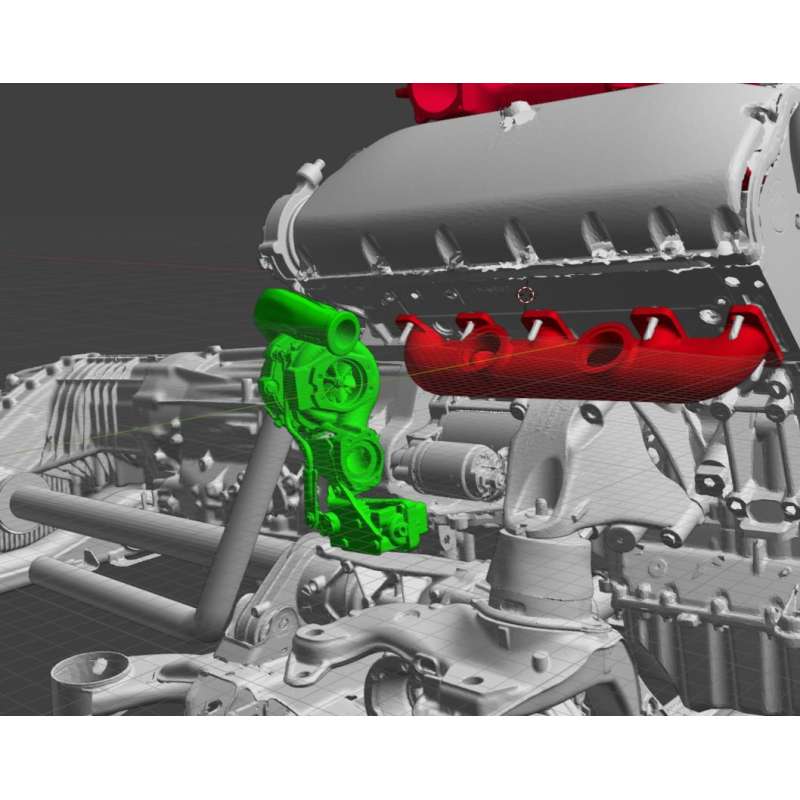
I built several 3D models, checked fitment by scanning the whole car and engine, and even printed plastic prototypes to test real-world clearances.
Since I’m in the EU, my goal was to keep the setup as close to stock as possible — easy EGR compatibility and no “monster headers” under the hood. (Here, even technical inspections are video-recorded and uploaded to a central state database, so everything needs to look OEM-ish.)
Stock manifolds:
The stock manifolds are stamped/welded pieces with a tiny shared chamber. The common collector pipe has an elliptical cross-section, but its area works out to about the same as a round 33 mm pipe. In other words, each 2.5 L five-cylinder is “breathing” through a 33 mm restriction before the turbo.
I get that they wanted a faster spool — especially with the stock turbo, which is basically a 1995 Renault unit with new housings — but in practice, anyone who switches to a GTB2260 with proper manifolds sees a faster spool than stock anyway.
Stock Engine Performance Analysis:
The next chart shows stock engine performance with an “all-in” tune, focusing on compressor pressure ratio and mass air flow. Each graph is presented as a trend to remove RPM from the picture and instead highlight the difference between 100% volumetric efficiency (VE) mass flow and the actual measured flow.

Key Point: The stock engine loses VE very quickly. From about 3000 RPM, it drops to ~70% VE. In other words, in stock form you pay for 4.9 L but are only effectively using ~3.5 L. No wonder a 3.0 V6 TDI can match or even outperform our 4.9/5.0 V10.
Based on dyno charts and logs from other “2-valve siblings” like the 1.9 TDI, some 2.0 TDIs, and flow metrics on V10 cylinder heads with stock cams, I determined that the huge 30%+ VE loss at mid RPM is not caused by the 2-valve layout or the cam profile.
There is a large air mass capacity available just before the intake, and the inability to open the VGTs further without losing boost indicates a choke somewhere in the exhaust flow before the turbine.
Under maximum load, when the compressor is working at full capacity, lifting off the throttle suddenly causes the VGT to open instantly, releasing pressure in the exhaust manifold. This is when you see a clear spike in MAF readings, jumping from ~1250 to ~1490 mg/cyc for some RPMs, thanks to the inertia of the compressor.
When the VGT opens rapidly, it causes a sudden drop in exhaust manifold pressure, which in turn leads to the VE spike observed in the MAF log. This rapid VGT movement increases VE temporarily but also sharply reduces turbine efficiency. I experimented with different VGT mappings to keep the VGT more open, but there wasn’t enough turbine efficiency to drive the compressor effectively. Ultimately, the limitation for air persists — either reduced power for the compressor or excess pressure in the exhaust manifold, which lowers VE.
According to Garrett compressor maps, the old (199s era) 52 mm compressor should be maxed around 25 lb/min before efficiency drops too much. In our V10 TDI engine, air stalls at ~23 lb/min and maintains that level. For newer 56 mm billet compressors used in hybrid setups, the mass limit for a 3:1 pressure ratio is around 36 lb/min. Given the low stock volute volume, say ~30+ lb/min, but you will only use ~22 lb/min due to VE constraints caused by the manifold/turbine design.
My plan:
Personally, I’m planning to try a GBC17-250 at back port and see if I can make it fit the stock location + WGs on front ports to raise VE. That meant I needed a better-flowing, more durable manifold design that could mount on either side of the engine.
Prototype:
In the next images, you can see the inside of the stock manifold and my first proposed model with two different V-band options: 1.5" and 1.75". Since each manifold needs identical V-bands for true left/right interchangeability in production, I settled on the 1.75" version.


Fitment check (old model):
For fitment verification, both 3D scanning of the car and engine and 3D printing of prototypes were used.


Refinement:
After CFD simulations of heat-induced (800°C, 6 bar) stress distribution, I decided to reinforce the casting. It was also found that more even gas flow between ports can be achieved by placing them closer together.


Production:
The first manufacturer promised a sample batch in 3 weeks, but delays and mold issues extended the process to over two months. After about six months of persistent communication, I was able to recover the funds according to the contract. I then switched to a second manufacturer, which was a smooth and professional experience. The result: high-quality samples that confirmed fitment and quality.
I was really pleased when I received the samples:


Preparing a kit:
Some minor polishing of the production instructions and drawings was applied for the final batch after receiving the samples. Then, finally, we made a full batch!
I also added a few small details to the delivery to make installation smoother and more enjoyable for whoever installs it.


Cast Stainless Exhaust Manifolds for V10 TDI – Ready
So now I'm offering a solution that is ready to ship.
This setup was developed both as a replacement for cracked OEM exhaust manifolds and as a strong, primary foundation for tuning and turbo upgrade projects.
About the kit
-
Cast exhaust manifolds made from AISI 304 stainless steel (5 mm wall thickness)
-
Universal fit — works on both left and right banks
- Each manifold features two symmetrical independent V-band 1.75" outlet ports:
-
Each v-band outlet is sized to support approximately 300 hp per bank, providing sufficient flow capacity for high-performance applications.
-
Flow capacity is based on internal cross-sectional area and real-world turbocharger operating conditions.
-
The second outlet can be used for:
-
EGR piping (adapter sold separately)
-
External wastegate for exhaust pressure relief when operating turbocharger near turbine flow limits
-
-
This dual-port configuration allows maximum flexibility in system design while maintaining balanced exhaust flow.
Possible Installation Options (components not included)
-
90° elbow to OEM turbo (Transfer Pipes, available separately)
-
Pipe to relocated or upgraded turbo
-
Quad-turbo configurations
-
EGR piping (adapter required, sold separately)
-
External pressure relief (e.g. when using OEM turbo with larger compressor)
Once installed, the cast manifolds are built to last.
V-BAND connections allow upgrades or changes to top-side components without engine removal.
(Pipes, elbows, and flex joints are not included in the kit.)
Can be used as a base solution (requires 90° elbow + bellow from the supplied V-band flange to the stock turbocharger) for both Touareg and Phaeton V10 TDI exhaust manifold replacement, left and right
(OEM: 07Z 253 033 / 07Z 253 034, incl. revisions).
What’s included
-
30 m basalt thermal wrap (50 mm width)
-
Stainless-steel wrap clamps
-
Set of V-BAND 1.75" flanges with quick-release clamps
(one per outlet, CNC-machined) including outlets -
V-BAND plug disk with NPT 1/8 sensor port
-
NPT 1/8 plugs (if sensors are not used)
-
2 pairs of JIC 1/4 → NPT 1/8 adapters (male/female), tested at 6+ bar
-
Steel template for correct manifold positioning on cylinder head
(thermal expansion compensation) -
12 mm steel drilling jig for alignment pins
-
Centering pins included
Advantages
-
No need to source or machine custom flanges
-
Everything pre-checked and designed for fast installation
-
Durable and flexible solution for both OEM replacement and performance builds
Additional accessories (sold separately):
- Transfer pipes from manifold to stock turbochargers
- V-band to stock EGR flange adapter
- PCV relocation kit
Contact: admin@specialstage.cz, WhatsApp/Telegram +420 776 798 203